Several Dead Whales
The first whale arrived on a Tuesday. It lay in the field behind the abandoned grocery store, where the grass never fully turned green and the wind always smelled like metal. By noon, half the town had come to stare at it. People stood in circles, hands in pockets, like they were watching a construction site instead of a dead whale.
No one knew who found it first. The rumor got out quickly, and the story kept changing. A mailman, a dog walker, or a kid cutting through the backyard of the abandoned store to skip school. But everyone agreed on the same detail that it hadn’t been there at sunrise.
The whale’s skin was gray and dull, not shiny and slick like in documentaries. It looked dusty, as if it had been rolled in flour. Its eye was half open and cloudy.
“This is a prank,” someone said.
“With what, a helicopter?” someone else answered.
There were no tracks or torn land. The grass bent around it, like it had been laid there by careful hands. By evening, the police put up yellow tape that fluttered uselessly in the breeze. The tape looked like it didn’t belong in that field. It made the whole thing look temporary, like the whale would be gone by morning, and everyone would pretend it was never there, and it was just a big misunderstanding. But in the morning, there were two…
The second one appeared by the football field, right between the bleachers and the rusted goalpost. Kids on their way to school saw it first but didn’t scream. They just stopped walking and stared at it, backpacks almost slipping off their shoulders.
“Oh, come on! I had a football game today!” One kid yelled, disappointed and a little angry. Another kid spoke up: “Me too, this sucks. Someone has to do something about these whales. They take up too much space.”
By noon, classes were canceled. People started whispering, not loudly or in a dramatic way, just quiet conversations like you’d usually have about your day during dinner with your family. They said it meant nothing, because what could it possibly mean? But in reality, a town that small couldn’t hold something that large without it meaning something.
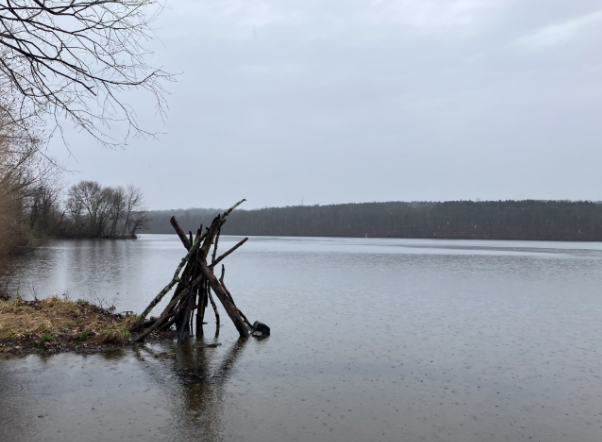
The third whale showed up by the lake. That one felt targeted and cruel. The lake was the only pretty thing here. Even in winter, when it froze, people came to sit near it. The benches were always worn because of how many people constantly sat on them. The whale lay halfway in the water, as if it had tried to go “home” but stopped. Its tail was on the shore, into the mud where kids used to play.
“Did it have to be the lake?” someone asked, annoyed.
“I know, right?! The kids and I were so excited for a picnic, here and now our plans are ruined,” A woman complained. The kids started pouting about wanting to play in the mud. Nobody really questioned the whale being there anymore.
That was the first time someone cried. It was Mrs. Parker who ran into the church. She didn’t make a sound, covering her mouth and sitting down quietly. Everyone saw how she was staring at that whale earlier, like she recognized it. Her shoulders started shaking, and she sobbed quietly.
After that, things started getting out of hand. Not all at once, just small things. People forgot appointments they’d kept for years. A man drove halfway to work before realizing the factory had closed three years ago. A woman set the table for five, then stood there staring at the extra plates like they’d multiplied on their own. The whales kept coming: One by the church, one by the parking lot of the dentist’s office, one in front of the library, and one in the middle of the main street where it blocked traffic for two whole days because no one could figure out how to move it. And always the same thing: no sound, no warning, no sign of how, and no reason why. The town started to smell like salt. It clung to everything, people’s clothes and hair, and it even stuck to the insides of your nose. They could taste it in their food if they didn’t wash the plate long enough. The air felt heavier. People stopped asking where the whales came from. Instead, they started asking when they would stop.
One night, a teenage boy snuck out into the field behind the abandoned grocery store. The first whale was still there. The tape was gone, and no one guarded it anymore. The town got tired of pretending it could control any of it, so people just gave up. The boy stood a few feet away and tried not to look at its eye, but he still did. The weird thing was, he didn’t see what he expected to see. Instead, he saw his own kitchen table, his two sisters and his mom sitting around it, eating quietly, and the light flickering above it. He stepped back so fast he nearly slipped. The eye became dull again.
The boy didn’t tell anyone, but the next day people started getting closer to the whales. Not touching, just staring into their eyes. He wondered if they were seeing the same thing he saw. He started to wonder if the whales weren’t lost, but maybe the people were. He started wondering if they washed up here the way memories usually do when they’re too big to carry but too heavy to sink and forget, so they just surface in your mind when you least expect it, just like the whales appeared in the middle of their lives when no one expected anything like it.
Author
Ketevan Giorgadze
Photographer: Chloe Tomlinson

